Manipulatives in Math Class Are So Worth It
January 3, 2026We’ve been involved in a wonderful partnership with our local elementary school. This puts us, occasionally, in the classroom of our own first grader (quite the treat!) as well as in all the other 1st and 2nd grade classrooms at the school.
It also lets us try out some new ideas and refresh old ones. One old idea we’ve come back to is that it’s absolutely essential to use manipulatives in math class, especially with young kids.
So here’s the story. Our friend at the district mentioned that she has access to tons of old Cuisenaire rods that are packed away in an old closet somewhere. We get them for all the first graders that we’re working with, and proceed to run a lesson with them, designed to connect the rods to numbers and equations.
But first, the kids need to play with them. In one class, we have to carve this time out when we come in to do the lesson. The the other two classes, the kids have a few extra days where the rods are available as a free play option, and they get more time with them.
Our lesson plan (linked here), was basically:
- Play (if they haven’t yet)
- Find the value of the rods if the white (1cm) rod is worth 1,
- Mathematize build some equations out of the rods
- Tackle a bigger question: how many different colors can make a single color line that’s equal to two orange (10cm) rods?
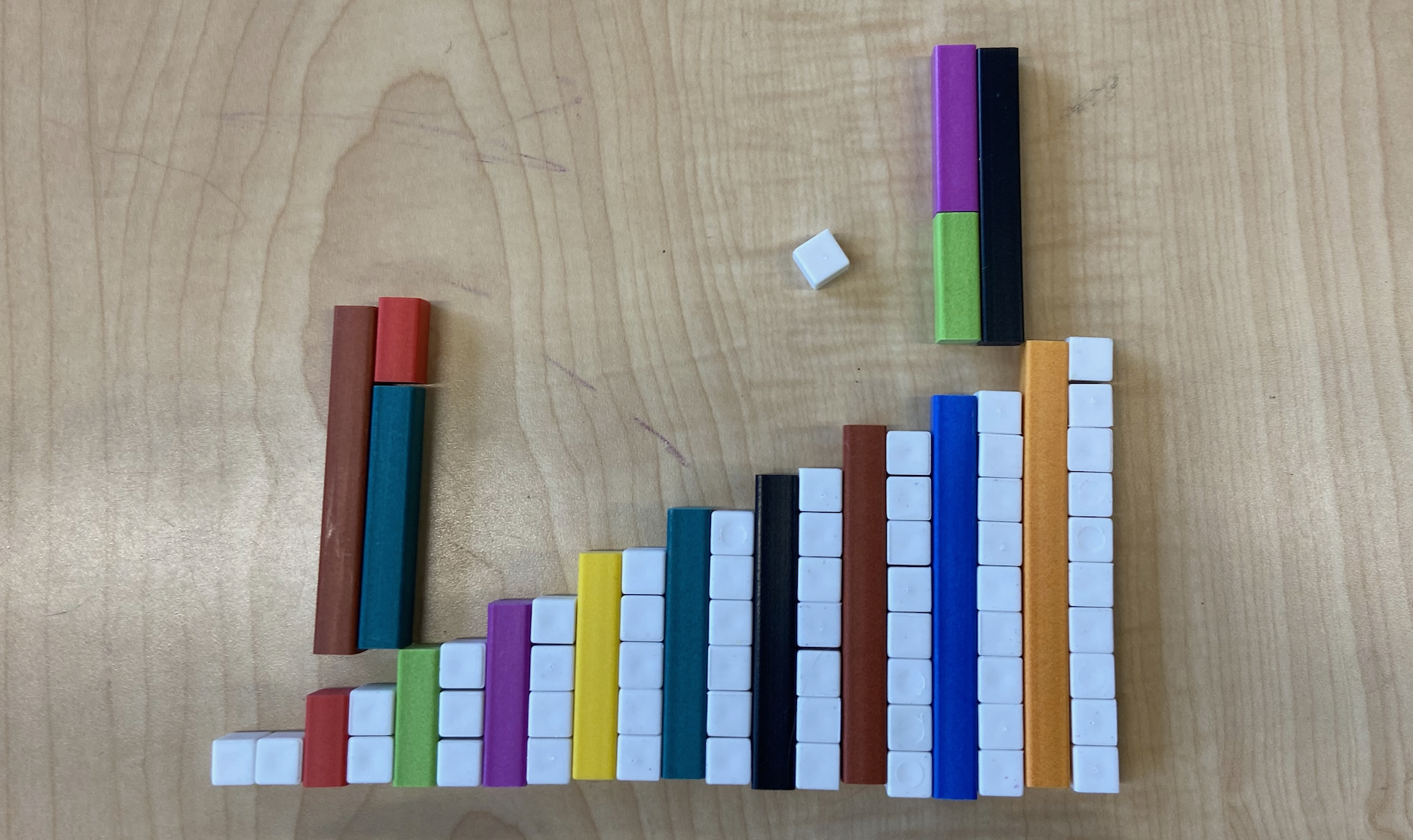
Takeaway 1.
The kids who had more time for free play with the rods made way more progress in the lesson. They made connections quickly that it took the other class much longer to make.
When it came to mathematizing – linking equations and the rods – the kids who had previous experience building and free playing with the rods made the connections far more readily. Playing with the rods seems to prime the mind to make connections. When you look at how naturally mathematical much of the free play is, it’s not that big a surprise.
Takeaway 2.
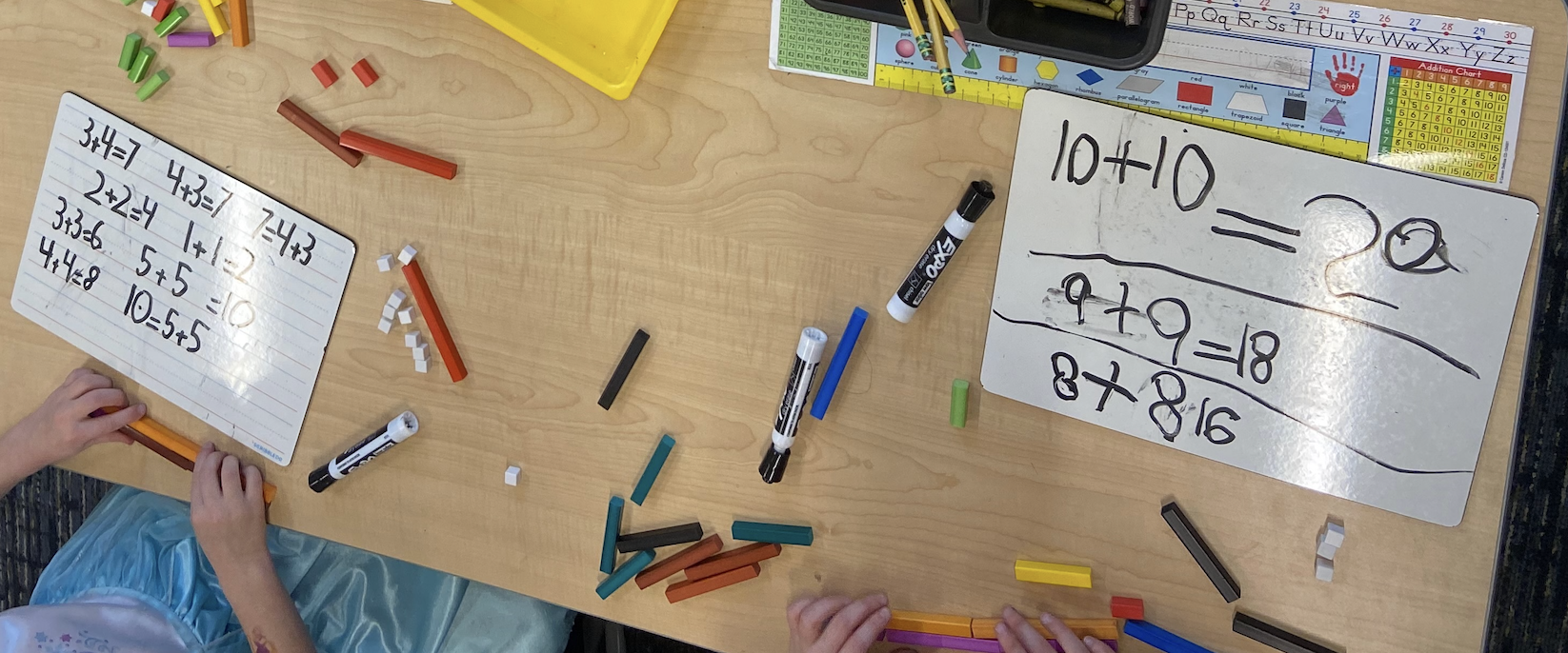
Using the rods upped dramatically how much math the kids did.
I had a moment when I was walking around the class to take note of just how prevalent and dense the math was in the class, and how focused the kids were. In a first grade classroom, it’s hard to sustain that level of focus for that long. With the rods, it went the other way – as kids got more comfortable and understood the object of the lesson, their focused deepened, rather than being exhausted. As they worked, kids were filling up their white boards with equations.
Takeaway 3.
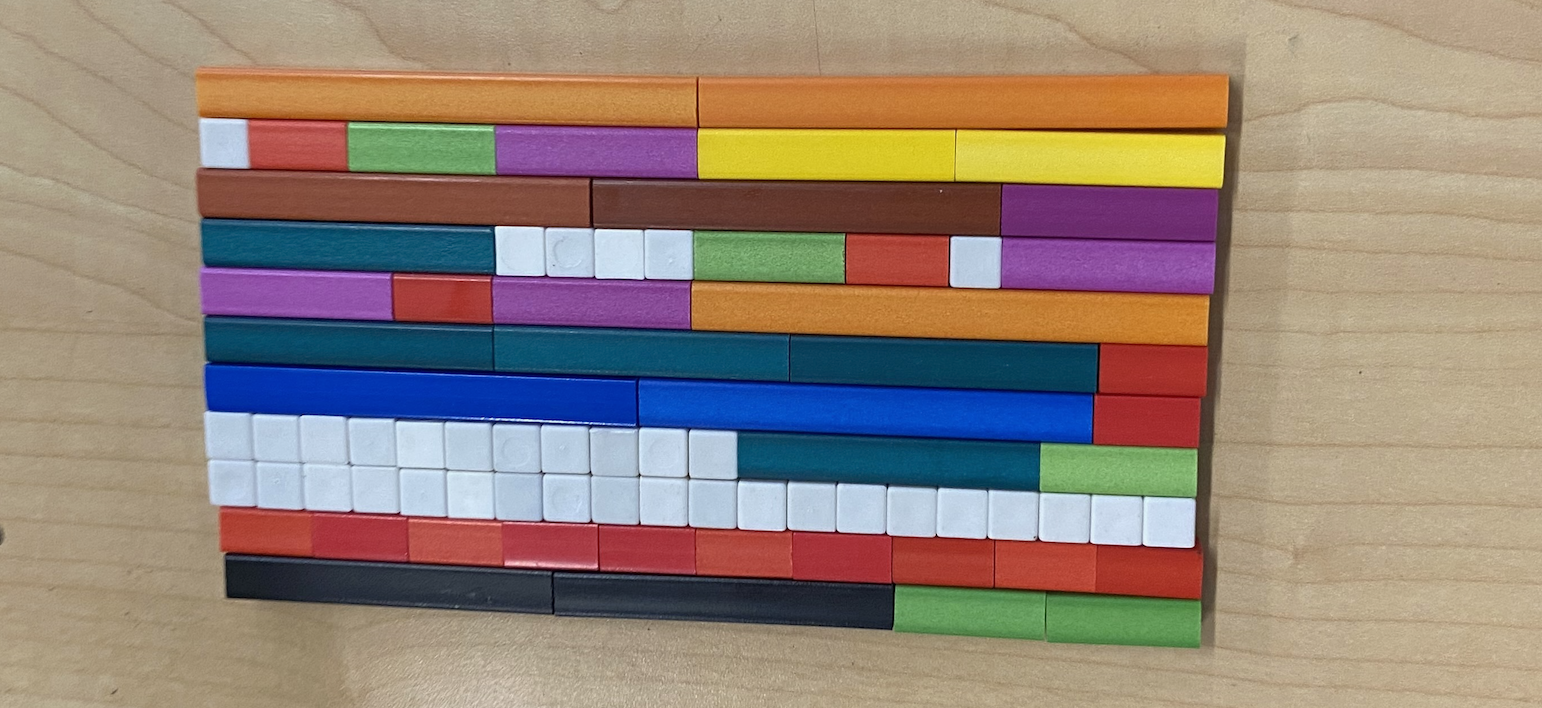
Even when students weren’t doing exactly what we’d asked, they were doing math.
Kids sometimes don’t listen to directions, or depart from them to do their own thing. But to a person, all the kids were doing interesting, relevant stuff. The image above was a good example of a kid who may have departed from the main question, but was still finding arrangements that lined up with 2 orange rods. (And if you look closely, it’s not totally obvious they’re not tackling the original question either, of finding single color lines that match up to two orange rods.)
Takeaway 4.
Manipulatives make it easier – even automatic – to differentiate.
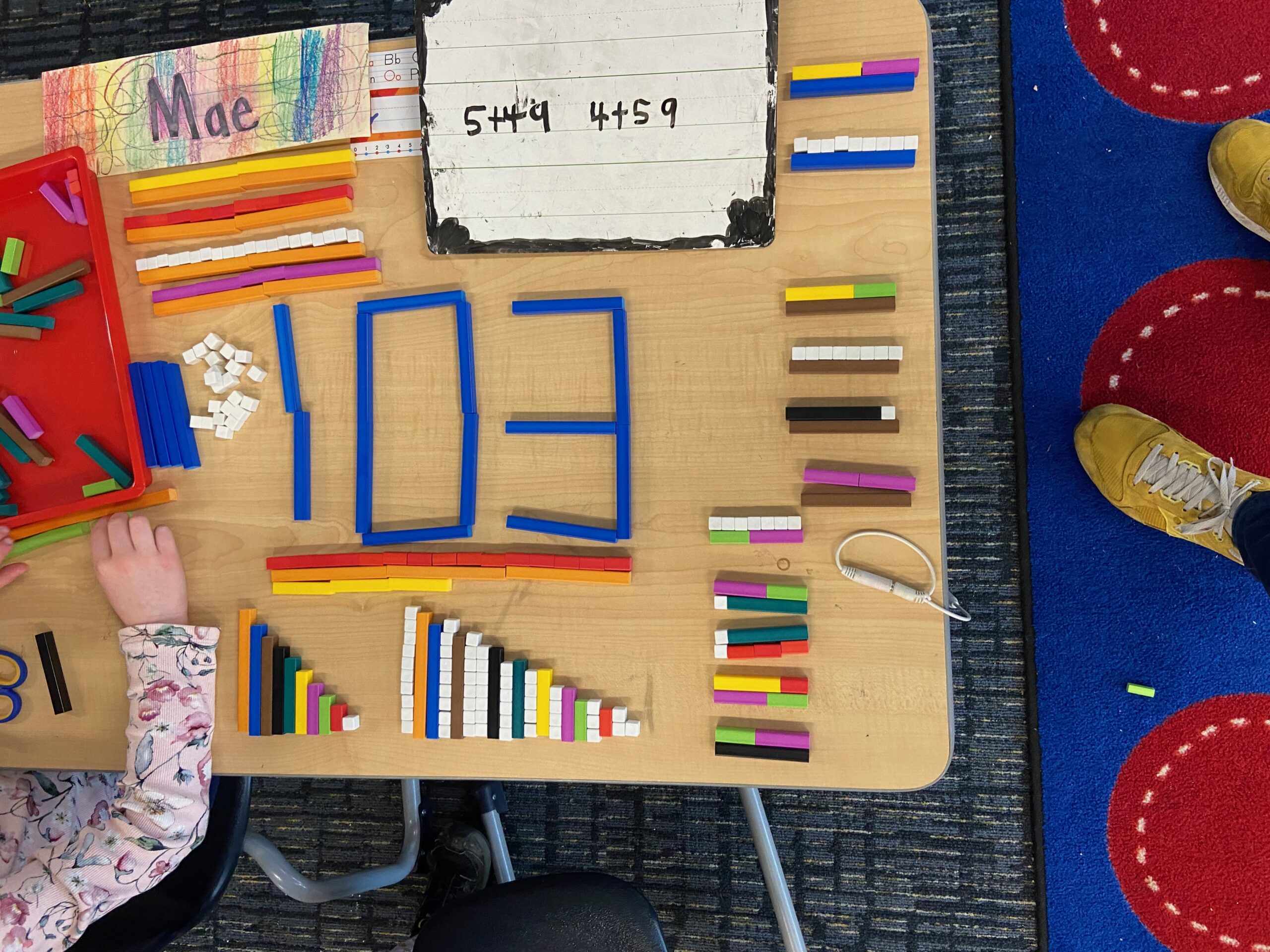
One student started counting and tracking how many white cubes she had on her desk. Every time I passed by her desk, the “counter” she had generated had ticked up. Having a first grader challenge herself after her work is done (because she was still engaged with the lesson) by giving herself what amounts to a large counting collection is a complete win. Similarly, when students finished the problem we had asked for 2 oranges, we could challenge them to try again for 3 oranges. Differentiating in this context was simply… easy!
Doing this kind of “counting collection” might have been a full class length lesson for a first grader. Instead, she’s giving herself the counting collection as a little side challenge between her time working. Here it was a bit later.
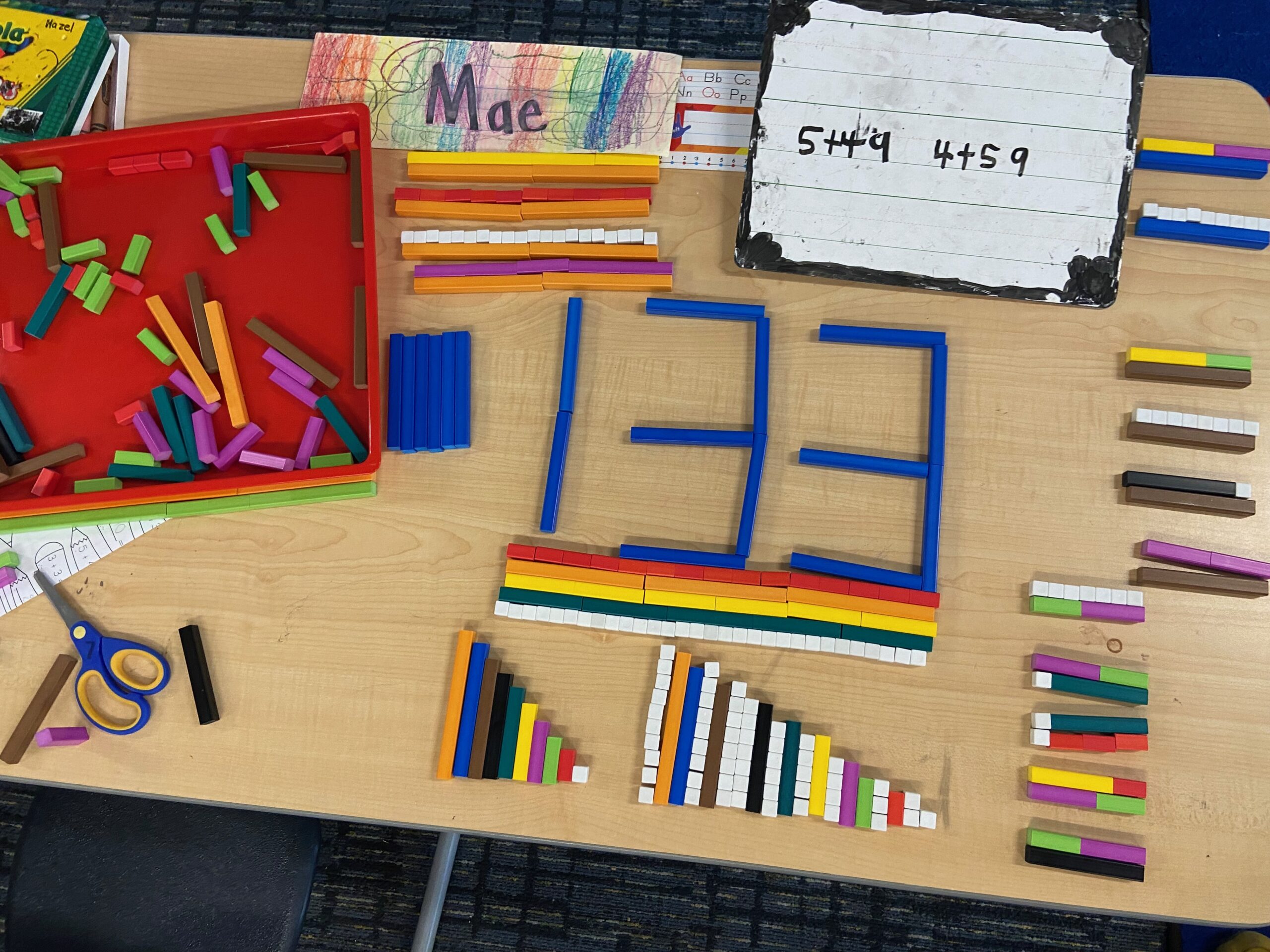
If you’re familiar with the rods, you can see that she’s involved in a tremendous amount of mathematics here, including solving the initial question for two orange rods, extending it to three orange rods, finding a bunch of ways to create one-digit sums with the same answer, and doing this counting collection to track total white cubes.
After doing this lesson in three 1st grade classrooms, I left convinced of how absolutely essential it is to use manipulatives like Cuisenaire rods especially in lower grades (K – 2), and really, in all elementary grades.
Thank you so much for sharing this lesson and your takeaways. I teach preservice elementary teachers and have lots of Cuisenaire Rods. They will be doing this activity soon.
That’s wonderful, Mark! Let me know how it goes!
I love this. I will be doing this lesson with some advanced K’s – we’ll see how far we get past playing, which seems like a great starting place. I feel lucky that at the start of this year, I received a bunch that were going to surplus, likely never to be seen again. I’m curious to see how they play. I’m so glad you posted this!
We have more Cuisesnaire rod lessons in our lesson library too. They’re one of the all-time great manipulatives.
Hope it goes well!
It went really well! I spent 20 minutes in K letting them play, with a little nudging by asking questions. I then ended 1st (which was the most interesting, and required the most refocusing) and 3rd with exploring the rods and asking questions. It was so easy to go harder (ok, so you, 3rd grader, figured out that 4 yellows equals 2 orange. So how much is an orange worth if a yellow is worth 7 instead of 5?) or easier for younger grades (what are all of the number pairs that make 10? Can you show me in colors?)… Read more »
That’s great! I love hearing the update 🙂
There’s so much you can do with the rods, especially as kids get older. You already hit on one of the easiest high leverage moves: change the value of one rod and then figure out all the others.
Can’t wait to get back to school after the break to do this with my students – so glad that I also saved the rods from the bin years ago. Thanks Dan.